


Timeline | La Ligne du temps
1600
Records from the 17th century provide the earliest evidence of a “manor” in Miradolo, with a vast estate, vineyards, and orchards, owned by the Macello family.
Les premières informations certaines révèlent qu’une “cassina” (ferme) existait déjà à Miradolo au XVIIe siècle, propriété de la famille Macello, avec de vastes terres, des vignes et des vergers.
end-1700s
Having become the Marquis of Caresana, Maurizio Massel began the renovation and expansion of the rural buildings, transforming them into an elegant noble residence. A garden of delights was created in the “formal” or “Renaissance” style with parterres and a fish pond, while the surrounding estate was farmed for food and animal fodder.
Maurizio Massel, devenu Marquis de Caresana, commence la restauration et l’agrandissement des bâtiments rustiques pour les transformer en une élégante demeure noble. Un jardin des délices est créé, “formel” ou “à l’italienne”, organisé en parterres et doté d’une pièce d’eau pour la pêche, tandis que les terres environnantes sont utilisées pour l’agriculture et la production de fourrage.
1820–1839
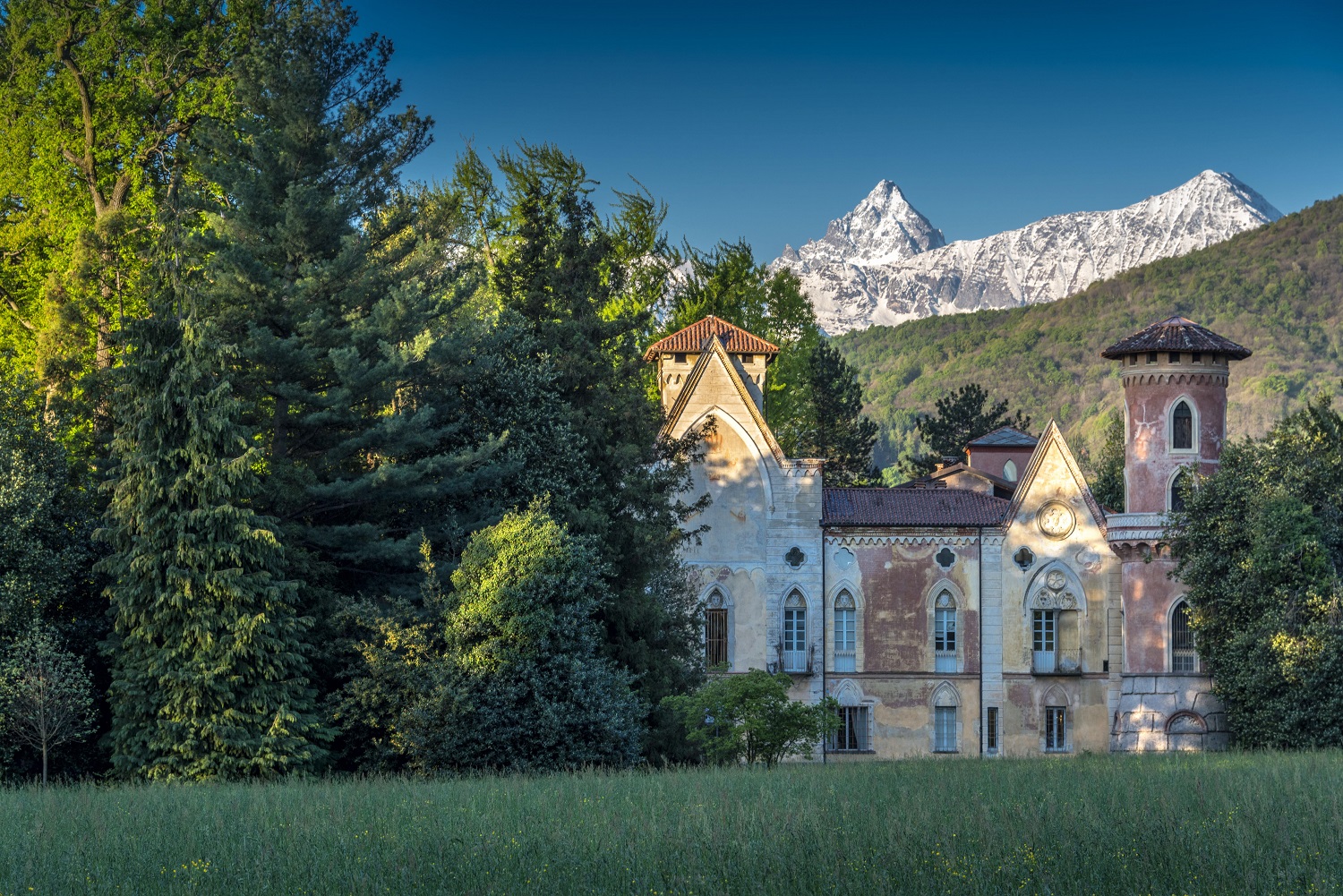
Maurizio Massel’s wife, Maria Elisabetta Ferrero della Marmora, known as “Babet,” now widowed and left with three small children, initiated the neo-Gothic restyling of Miradolo Castle. The renovation project was designed by the architect Giuseppe Talucchi.
Maria Elisabetta Ferrero della Marmora, dite “Babet”, devenue veuve avec trois jeunes enfants, se consacre au remaniement du Château de Miradolo dans un style néogothique . L’architecte Talucchi est le concepteur des travaux.
1824
The renowned landscape architect Xavier Kurten was called to redesign the castle’s gardens. The eighteenth-century layout was abandoned, with the fish pond transformed into a small lake and the park expanded and developed around a central Great Lawn. In keeping with the fashion of the “English” landscape garden, the sensuous and seemingly spontaneous design sought to elicit surprise and intrigue through the scenographic arrangement of shapes and colors.
Le grand paysagiste Xavier Kurten conçoit le jardin du château. L’aménagement du XVIIIe siècle est radicalement transformé. La pièce d’eau devient un petit lac et le parc s’agrandit et se développe autour du grand pré central. Les lignes sinueuses et l’irrégularité, typiques du goût “informel” ou “à l’anglaise”, visent à susciter surprise et, en même temps, curiosité, grâce à des effets scénographiques obtenus par l’association de formes et de couleurs.
1831
The greenhouse was built.
La serre est édifiée.
1839
The Round Tower was built to celebrate the wedding of Elisabetta’s son.
À l’occasion du mariage du fils d’Elisabetta, la tour ronde est construite.
1866
Babet’s grand-daughter Teresa Massel di Caresana married Luigi Cacherano di Bricherasio. To mark their union, the castle’s facades were adorned with the escutcheons of the Massel family (three hammers) and the Cacherano family (a striped field with black and silver indented lines).
Le mariage entre la nièce de “Babet”, Teresa Massel di Caresana, et Luigi Cacherano di Bricherasio est célébré. Les blasons nobiliaires, symboles des familles Massel (trois marteaux) et Cacherano (un champ fascé, enté de noir et d’argent), sont insérés sur les façades du château.
1867
Sofia Cacherano di Bricherasio, the eldest daughter of Luigi Cacherano di Bricherasio and Teresa Massel di Caresana, was born. Trained by the painter Lorenzo Delleani, her passion for painting led her to exhibit at the first Venice Biennale. Sofia and Teresa brought artists and intellectuals to Miradolo Castle, creating a true cultural cenacle.
Naissance de Sofia Cacherano di Bricherasio, fille aînée de Luigi Cacherano di Bricherasio et de Teresa Massel di Caresana. Élève du peintre Lorenzo Delleani, sa passion pour la peinture l’amène à participer à la Ière Biennale de Venise. Le château de Miradolo devient un cénacle culturel où Sofia et Teresa accueillent artistes et intellectuels.
1869
Emanuele Cacherano di Bricherasio, Sofia’s brother, was born. In 1895, he promoted Italy’s first motor race and established the Italian Automobile Club (ACI). In 1899, he was promoter, leading investor, and one of the nine founding shareholders of the Fabbrica Italiana Automobili di Torino, better known today as FIAT.
Naissance d’Emanuele Cacherano di Bricherasio, frère de Sofia. En 1895, il promeut la première course automobile italienne, fonde l’ACI (Automobile Club Italiano) et, en 1899, est le promoteur et le principal financier parmi les 9 associés fondateurs de la FIAT “Fabbrica Italiana Automobili di Torino”.
1871
Elisabetta Ferrero della Marmora died.
Décès d’Elisabetta Ferrero della Marmora.
1904
Emanuele Cacherano di Bricherasio died during a stay at Agliè Castle, in circumstances that still remain a mystery.
Emanuele Cacherano di Bricherasio décède au château d’Agliè, dans des circonstances qui n’ont pas encore été éclaircies.
1907
Captain Federico Caprilli, known throughout the world for having developed the forward seat riding position that revolutionized equitation, died. His friendship with Emanuele developed over their years together at the military academy and the “Piemonte” cavalry regiment in Saluzzo. Caprilli was a regular guest at Miradolo Castle, and it was here that he met Countess Sophia, with whom he became close.
His death, like that of his friend Emanuele, would never be convincingly explained. It would seem he fell from his horse on slippery terrain and hit his head.
At the behest of the Countess, he was buried alongside her brother Emanuele in the family chapel in Fubine, created by the sculptor Leonardo Bistolfi.
Décès du capitaine Federico Caprilli, connu dans le monde entier comme l’inventeur du système d’équitation naturelle. Son amitié avec Emanuele commence pendant les années de l’académie militaire et la période passée au régiment de cavalerie “Piemonte” à Saluzzo. Caprilli fréquente assidûment le château de Miradolo, où il rencontre la comtesse Sofia, à laquelle il est lié par une profonde amitié. Sa mort, comme celle de son ami Emanuele, est liée à des événements qui restent à élucider : une chute de cheval sur un terrain glissant semble être la cause du grave accident dans lequel il a été impliqué. Selon la volonté de la comtesse, il est enterré dans la chapelle de famille, réalisée par le sculpteur Leonardo Bistolfi, à Fubine, à côté de son frère Emanuele.
1923–1950
Teresa Massel died. As the last in the line of the family, her daughter Sofia abandoned painting to devote her time to charity and welfare work.
During the Second World War she left her habitual home in Turin and moved permanently to Miradolo, bringing with her the family’s possessions and archive.
Décès de Teresa Massel. Sa fille Sofia di Bricherasio, restée seule, abandonne la peinture pour se consacrer à des œuvres de bienfaisance et d’assistance. Pendant la Seconde Guerre mondiale, elle quitte le palais de Turin, où elle réside habituellement, pour s’installer définitivement à Miradolo, emportant avec elle les biens et les papiers de famille.
1950
Sofia died. Miradolo Castle was included as part of the rich bequest left to the Little Work of Divine Providence founded by Don Luigi Orione, which transformed the castle and its park into a spiritual retreat and summer home for the elderly. Renovations from the 1950s to the 1990s greatly impacted the architectural plan and decorative features of the castle, in some cases irreparably, as well as the layout of the landscaped park.
Décès de Sofia. Le château de Miradolo est inclus dans le riche legs testamentaire en faveur de la Piccola Opera della Divina Provvidenza de Don Orione, qui utilise le palais et son parc comme maison de retraites spirituelles et résidence d’été pour personnes âgées. Jusqu’aux années 90 du siècle dernier, les interventions compromettent, parfois de manière irrémédiable, l’architecture et les décorations du château, ainsi que l’aménagement paysager du parc.
Mid-1990s–2007
Miradolo Castle was abandoned and left in a complete state of neglect.
Le château de Miradolo est abandonné et connaît des années d’oubli total.
2007
The property was acquired by a group of private investors, with a view to transforming it into a cultural venue. Restoration work on the building and the historical park was started.
Un groupe de particuliers achète la propriété dans le but d’en faire un lieu culturel. Les restaurations du palais et du parc historique commencent
2008
The Cosso Foundation was established. Miradolo Castle was assigned to the new entity and officially opened to the public in October the same year with an inaugural exhibition on Delleani and his school. For the castle’s reopening, extensive structural work was carried out on the roof and the plant systems, which were completely degraded. In the years that followed, the foundation grew, developing its five thematic areas of interest—art, music, nature, learning & education, and community welfare—and the multidisciplinary approach that underpins its mission of promoting broadly diversified cultural production.
Naissance de la fondation Cosso. Le château de Miradolo, confié à la nouvelle entité, est officiellement ouvert au public en octobre. Pour la réouverture, avec une exposition dédiée à Delleani et à ses élèves, des travaux structurels sont effectués sur les toits et les installations de la demeure, profondément dégradés. Suivent des années où la fondation grandit et développe les 5 domaines d’activité imaginés : art, musique, nature, didactique et formation, social. Une multidisciplinarité qui caractérise son identité, à travers la conception et la production culturelle de plus en plus vaste et diversifiée.
2009
The halls of the Noble Wing were restored, entailing the demolition of the curtain walls that had been installed by the religious congregation that had received the castle in bequest. The walls had served to “break up” the spacious halls of the wing into cramped rooms with bathrooms. These rooms originally housed the private apartments of the Cacherano di Bricherasio family. The family’s furnishings were sold off or stolen over the years, including a four-poster bed featuring ornate “bandera” embroidery.
Avant-dernière pensée was set up to become today the resident art collective at Miradolo Castle. Its sound productions and installations compellingly combine art and music, engaging with the interiors of the castle and its external grounds and breaking down the traditional wall between the audience and performers. Ever since, all exhibitions hosted at Miradolo Castle have featured a sound installation.
The SM-Stare Meglio project was started up in partnership with the Dept. of Psychology of the University of Turin and the Regional Center for Multiple Sclerosis–CRESM of the San Luigi Gonzaga Hospital of Orbassano, coordinated by Professor Silvia Bonino. The project gives patients the chance to receive group psychological and medical support in a non-hospital environment, in contact with beauty and nature—an experience which has been demonstrated to have a positive effect on patients with neurodegenerative diseases.
Les salles de l’aile noble sont restaurées avec la suppression des cloisons intérieures qui « fragmentaient » les espaces aérés d’origine, transformés en chambres exiguës avec salle de bain par la congrégation religieuse à qui le château avait été donné. Ces salles abritaient à l’origine les appartements privés de la famille Cacherano di Bricherasio. Au fil des ans, les meubles, comme le lit à baldaquin décoré de broderies bandera, ont été volés ou vendus. Au niveau du projet, est né Avant-dernière pensée, qui est aujourd’hui en résidence au château de Miradolo : des productions et installations musicales et artistiques qui établissent des liens entre les disciplines, dépassant la distance traditionnelle qui sépare public et interprètes et se modelant sur les espaces intérieurs et extérieurs de la demeure. À partir de ce moment, les expositions s’enrichissent de l’installation sonore. Le projet de recherche SM-Stare Meglio (Se Sentir Mieux) est également lancé, en collaboration avec le département de psychologie de l’Université de Turin et le CRESM-Centro di Riferimento Regionale Sclerosi Multipla (Centre de Référence Régional Sclérose en Plaques) de l’hôpital San Luigi Gonzaga d’Orbassano, sous la coordination scientifique de la Prof. Silvia Bonino : vivre des expériences de soutien psychologique et physique en groupe dans des environnements extra-hospitaliers, au contact de la beauté et de la nature, modifie la réponse à la maladie neurodégénérative des patients.
2010
The neo-Gothic greenhouse was restored. After its repurposing as a canteen and then the years of neglect, the greenhouse today stands in all its former glory, providing a venue of great charm for contemporary events, thanks to the discreet installation of heating, lighting, and automation systems.
La serre néogothique est restaurée. Après sa transformation en réfectoire et les années d’abandon, la récupération a rendu à ce lieu son charme d’origine, tout en l’adaptant à des usages contemporains, grâce à l’insertion discrète et respectueuse des systèmes de chauffage, d’éclairage et de domotique.
2012
Restoration work began on the Historical and New Wings, continuing through to 2014. Structural work was also carried out on the facades of the Noble Courtyard to secure the modular brick elements making up the crown cornice along the roof line and stylish belt courses marking out the storeys of the building.
La restauration des ailes historique et neuve commence, et se poursuivra jusqu’en 2014. La même année, des travaux sont entrepris sur la façade de la cour noble, consolidant les couronnements supérieurs et les élégantes corniches de niveau constituées d’éléments modulaires en terre cuite.
2014
The old chapel dedicated to St. John the Baptist was restored.
L’ancienne chapelle dédiée à Saint Jean-Baptiste est restaurée.
2015
The Round Tower was restored, with work targeted at repairing the roof, securing the balcony, and cleaning the decorative elements.
The exhibition Caravaggio and His Time was held at Miradolo Castle, featuring the Penitent Magdalene kindly on loan from the Doria Pamphilj Gallery in Rome.
La tour ronde est restaurée, le toit est réparé, le balcon consolidé et les décorations retrouvent une nouvelle vie. À l’occasion de l’exposition Caravaggio e il suo tempo (Le Caravage et son temps), la Madeleine pénitente de la galerie Doria Pamphilj de Rome est exposée au château de Miradolo.
2016
The Cosso Foundation expanded the scope of its work with Progetto Ulisse, a multidisciplinary education project for secondary schools that explores the use of artistic and performance languages for developmental growth.
Les projets de la fondation s’élargissent : naissance du Progetto Ulisse (projet Ulysse), le parcours multidisciplinaire d’éducation et d’orientation vers la créativité, dédié à l’enseignement secondaire, visant à explorer les langages artistiques et performatifs comme outils de croissance.
2017
The exhibition Fausto Melotti. When Music Becomes Sculpture was held, exploring the links—like all our exhibitions—between the works, the venue, and music.
As is our custom, the exhibition was designed, developed, and organized fully by the foundation. It also marked the introduction of the new One Meter Down® educational tour for ages 0–99.
The exhibition was paradigmatic of the approach espoused by the foundation, combining critical interpretation, formal respect, research, and innovation.
The first complete and accessible tour of the park was inaugurated.
L’exposition Fausto Melotti. Quando la musica diventa scultura (Quand la musique devient sculpture) se développe, comme pour toutes les autres expositions, autour du lien entre les œuvres, le lieu et la musique. L’aménagement est, comme d’habitude, conçu et réalisé en interne. Le nouveau parcours didactique 0-99 ans Da un metro in giù® (De moins d’un mètre) est lancé. L’exposition est le paradigme d’une approche typique de la fondation : lecture critique, respect formel, recherche et innovation. Le premier parcours de visite complet et accessible du parc est inauguré.
2018
Five trees in the park were given ministerial heritage protection as natural monuments: the Ginkgo Biloba, the Taxodium distichum or bald cypress, the yew, the European hornbeam, and the tulip tree. A tree is said to be monumental when, for its size, longevity, rarity, or historical, natural, or cultural interest, its heritage value is formally recognized by law.
Le caractère remarquable de 5 arbres du parc (le ginkgo biloba, le taxodium distichum ou cyprès chauve, l’if, le charme et le tulipier de Virginie) est notifié par un acte de classement ministériel. Un arbre est dit remarquable lorsque, par sa taille, sa longévité, sa rareté, son intérêt historique, paysager ou architectural, il est reconnu par l’État comme un sujet végétal d’une valeur naturaliste, historique et culturelle particulière.
2019
As part of a major project to repopulate the historical gardens and protect their biodiversity, more than 130 rare cultivars of camelias were introduced, adding to the park’s rich historical camelia grove.
Dans le cadre d’un important projet de repeuplement du jardin historique et de sauvegarde de la biodiversité, plus de 130 rares exemplaires de cultivars de camélias sont insérés, enrichissant la caméliaie historique du parc.
2021
The castle’s vegetable patch and farmyard area were redesigned by the architect Paolo Pejrone. The vegetable patch was given a circular shape that is harmonious, closed, and protected. The one- and two-story farm buildings present all the canonical features typical of an eighteenth-century Piedmontese farm.
Countess Sofia’s painting studio was also restored.
Le potager du château et la cour rustique sont conçus avec l’architecte Paolo Pejrone. Le potager a une forme circulaire : harmonieux, clos, protégé. Les bâtiments rustiques, à un ou deux étages, respectent la typologie constructive canonique et les fonctions de la ferme piémontaise du XVIIIe siècle. L’ancien atelier de peinture de la comtesse Sofia est également restauré
2022
The coat-of-arms was restored on the main facade overlooking the central Great Lawn, featuring fresco and dry-painted elements.
One year after the passing of Christo Vladimirov Javacheff and in partnership with the Christo and Jeanne-Claude Foundation in New York, the Cosso Foundation organized Christo & Jeanne-Claude. Projects, the first anthological exhibition in Italy dedicated to the visionary couple that revolutionized the concept of the art work and the process of its making.
Le blason sur la façade principale donnant sur le grand pré central, réalisé à fresque avec des finitions à sec, est restauré. Un an après la disparition de Christo Vladimirov Javacheff, la fondation Cosso, en collaboration avec la fondation Christo et Jeanne-Claude de New York, organise la première exposition anthologique en Italie dédiée au couple visionnaire qui a révolutionné la façon de concevoir l’œuvre d’art et son processus de réalisation : Christo et Jeanne-Claude. Projects.
2022–2024
The Cosso Foundation was the first entity in Piedmont, and just the eighth in the north-west area of Italy, to obtain NRRP funding under the program for the protection and promotion of historical parks and gardens. The funding permitted extensive maintenance work and repairs to be completed.
Working with the architect Paolo Pejrone, the layout of the courtyards and pathways was restored to the pre-1900 design on the basis of a study of archival records. With a view to protecting the park’s biodiversity and enhancing the attractiveness of Miradolo Castle as a tourist destination, the undergrowth and perimeter wooded areas were restored and varieties of shrubs introduced to support bird life and insect pollinators. The lighting and irrigation systems were repaired and renovated, with the original irrigation canals put back into use to reduce water consumption. Efficiency improvements were made to the visitor management system through the introduction of centralized digital systems. Reception and visitor services were also modernized, improving accessibility, including new audio guides and inclusive information panels in the park, new counters and ticketing services, and innovations to the educational program for schools and families.
La Fondation Cosso, première dans le Piémont et huitième au classement national du nord-ouest, obtient une contribution des fonds PNRR (Plan National de Relance et de Résilience) dans le programme de protection et de valorisation des parcs et jardins historiques. Les interventions sont nombreuses, d’entretien ordinaire et extraordinaire et sur plusieurs domaines de travail. Avec l’architecte Paolo Pejrone et sur la base de documents d’archives, le projet paysager perdu dans la première moitié du XXe siècle est récupéré, redessinant les lignes et les environnements des cours et des parcours. Dans une optique de sauvegarde de la biodiversité et de renforcement de l’attractivité touristique, les sous-bois et les zones boisées périphériques sont rétablis. Des espèces arbustives sont insérées, également pour soutenir l’avifaune et les insectes pollinisateurs. Les systèmes d’éclairage et d’irrigation sont restaurés et mis à jour, récupérant l’ancien système de canaux dans le but de réduire la consommation. Les systèmes de gestion du public sont optimisés grâce à des systèmes de contrôle centralisés et numériques. Les services d’accueil et de visite sont renouvelés, également dans une optique d’accessibilité : de nouveaux audioguides et panneaux inclusifs dédiés au parc, l’adaptation des comptoirs et des services de billetterie, l’innovation du programme didactique pour les écoles et les familles.
2023
The Cosso Foundation was awarded a grant for organizational and management innovations by the Compagnia di San Paolo Foundation under its Next Generation You program. Designed to support third sector organizations in pursuing innovation, sustainability, and autonomy through their organizational rationalization and growth, the funding program is aimed at furthering the ability of those organizations to promote the growth and development of their local areas and deliver widespread and lasting benefits for the community.
Marking the year of artist’s death and the 15th anniversary of the Cosso Foundation, the exhibition Irma Blank. Between Sign and Silence was held to celebrate an artist who transformed the relationship between words and pictures. The visitor tour became more inclusive with Audio Descriptive, Italian Sign Language (LIS), and Augmentative and Alternative Communication (AAC) material introduced, alongside English and French translations of texts.
La fondation Cosso se voit attribuer une contribution pour l’innovation et le renforcement de la gestion et de l’organisation, grâce au programme de financement Next Generation You de la Fondazione Compagnia di San Paolo. Visant à accompagner les organisations du tiers secteur dans les processus de rationalisation et de croissance relatifs à leur innovation, leur durabilité et leur autonomie, l’appel à projets est destiné à soutenir la capacité de ces organisations à être des leviers de développement pour le territoire dans lequel elles opèrent et à y apporter des bénéfices diffus et durables. L’année de sa disparition et à l’occasion des 15 ans de la fondation Cosso, l’exposition Irma Blank. Tra segno e silenzio (Entre signe et silence) est dédiée à l’artiste qui a transformé la relation entre parole et image. Le parcours de visite devient inclusif : aux langues anglaise et française, s’ajoutent les traductions en audiodescription, LIS (Langue des Signes Italienne) et CAA (Communication Alternative Augmentée).
2025
The visitor tour of the castle was inaugurated, exploring its history and restoration and the families that left their mark on it.
Naissance du parcours de visite dédié au château : histoire, restaurations et familles qui ont fait son histoire.